Medialingo
Clear, credible content from complex expertise
I help B2B organisations turn expert input and complex source material into clear, credible and publishable content.20+ years’ editorial experience across energy, commodities, technology and professional services.
Paul Maguire

Editorial & Content Specialist
Thought leadership, editorial development, website content and digital publishing support. More than 20 years across energy, commodities, technology and professional services, including S&P Global/Platts, Argus Media and ENSEK.
SERVICES
Editorial support from source material to publication
Thought leadership, content development, website publishing and English-language refinement for B2B organisations.
Thought leadership and expert content
Turning interviews, transcripts and specialist knowledge into clear, credible content without losing the expert’s voice.
Executive interviews · Thought leadership · SME content · Case studies
Website content and digital publishing
Creating, editing and managing content for websites, including migrations, CMS publishing and pre-launch editorial QA.
Website editing · CMS publishing · Content migration · Launch QA
Editorial development and AI content QA
Taking rough, inconsistent or AI-assisted drafts and making them publication-ready through structural editing, fact-checking and careful editorial judgement.
Structural editing · AI-content review · Tone and clarity · Fact-checking
Content review and quality control
A final editorial check for content that is already substantially complete but needs another pair of experienced eyes before publication.
Accuracy · Consistency · Structure · Style · Publication readiness
CONTACT
Have something that needs editorial work?
Have a draft, transcript, website project or AI-assisted content that needs editorial work? Send me the audience, format and current stage.
Medialingo
SELECTED WORK
Content strategy, editorial development and specialist publishing
Professional, independent and speculative work across B2B, technical and consumer content. Each example explains the purpose, my contribution and the resulting output. Independent and speculative projects are clearly identified.
PROFESSIONAL CONTENT & STORYTELLING
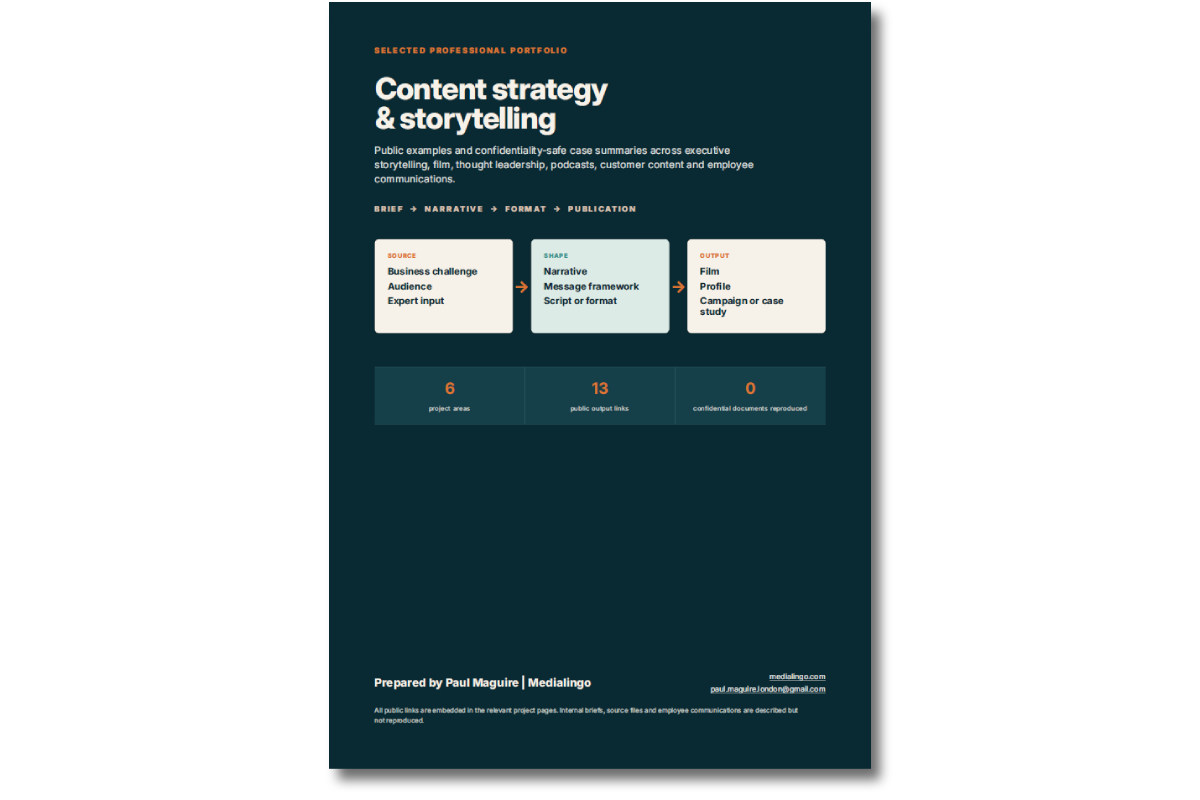
From Brief to Publication
Selected professional work across executive interviewing, thought leadership, film, podcasts, customer storytelling and employee communications, including published examples and confidentiality-safe project summaries.
Interviewing · Editorial development · Storytelling · Publishing
EDITORIAL DEVELOPMENT & PUBLICATION QA
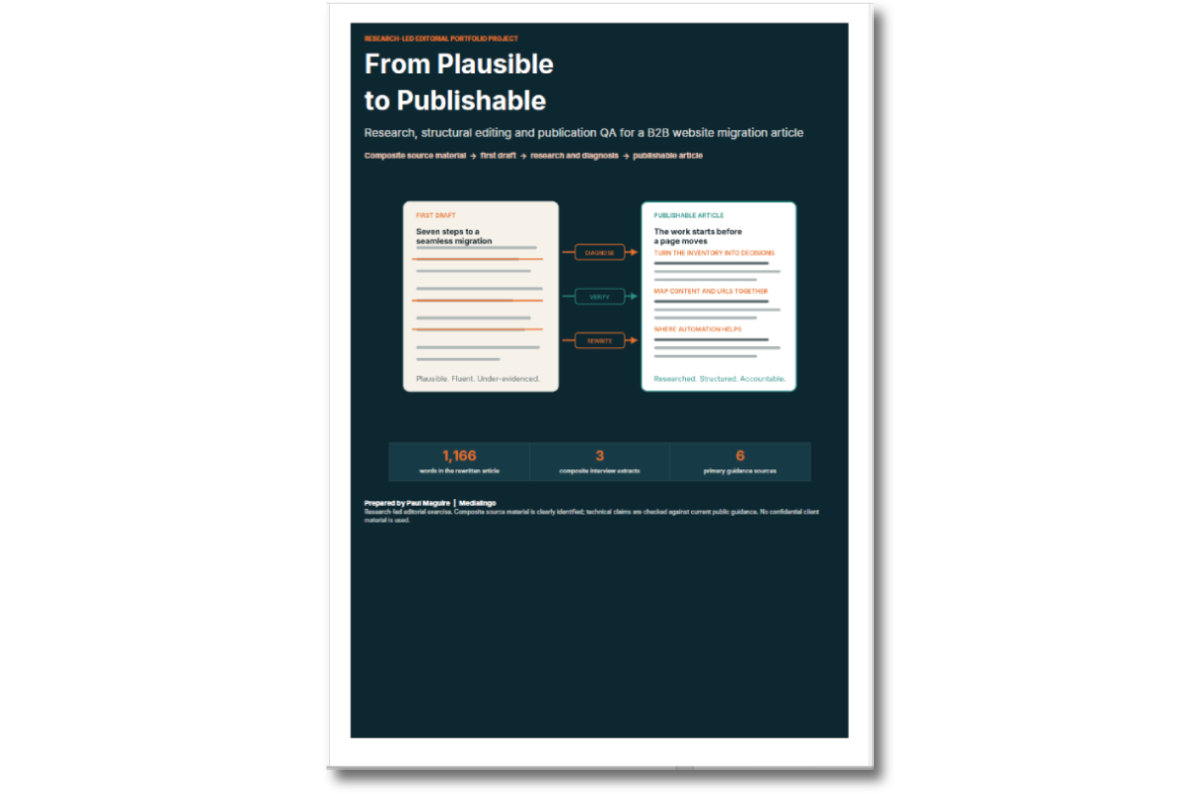
From Plausible to Publishable
A research-led editorial case study taking composite interview material and a plausible first draft through research, structural editing, fact-checking and QA to a clear, credible B2B article.
Interview development · Structural editing · Research · Editorial QA
B2B CONTENT STRATEGY & CAMPAIGN
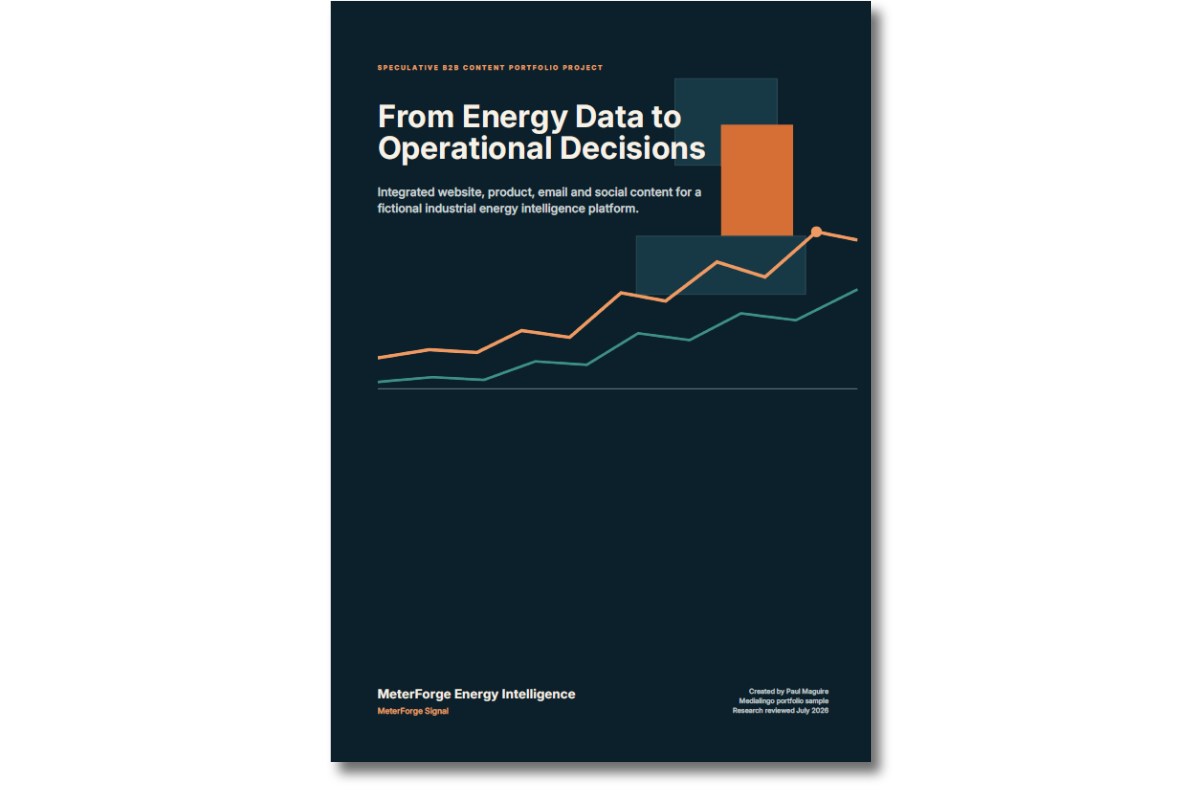
From Energy Data to Operational Decisions
An integrated B2B content campaign showing how a complex industrial energy proposition can be developed into clear, audience-specific messaging across website, product, email and social content. Created as a speculative portfolio project.
Positioning · Product copy · Email · Social
Other editorial work
TECHNICAL & PATIENT INFORMATION

DBS vs Focused Ultrasound for Essential Tremor
An evidence-based patient guide showing how complex technical and medical information can be researched, structured and explained clearly while preserving nuance, balancing risk and managing sources carefully.
Research · Technical simplification · Source management · Editorial QA
TRAVEL EDITORIAL & VISUAL PUBLISHING
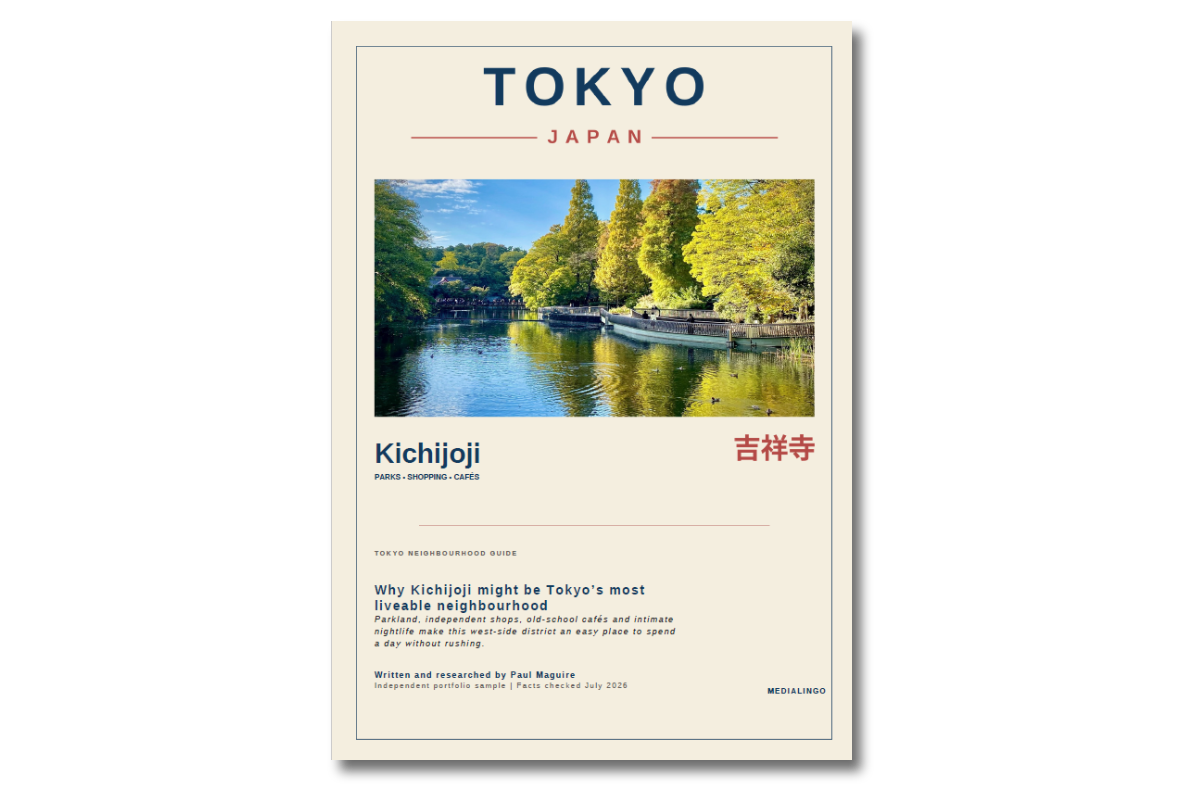
Kichijoji: Tokyo Neighbourhood Guide
An independently researched long-form guide combining editorial structure, destination writing, practical information, source management, image sourcing and visual publishing.
Long-form writing · Research · Information design · Visual publishing
HOW I WORK
From source material to something ready to publish.
01 — Understand the brief
I start with the audience, purpose and source material: what the content needs to do, what already exists and where the problems are.
02 — Shape and strengthen
I structure, edit and verify the content, keeping the expertise and original voice intact rather than simply polishing the wording.
03 — Make it publishable
I check clarity, consistency and the final details, then deliver content ready for review, publishing or the next stage of production.
Insights
Reflections on editorial judgement, AI-assisted content, expert interviews and digital publishing.
4. AI Can Make Content Clear. It Cannot Decide Who It Is For — Why a polished draft still needs a clear audience, a useful purpose and editorial judgement.
3. A Website Migration Is an Editorial Project, Not Just a Technical One — Why moving to a new CMS should also mean deciding what content deserves to move, what needs improving and what can be left behind.
2. A Transcript Is Source Material, Not an Article — Why expert conversations still need selection, verification, structure and editorial judgement before they become publishable thought leadership.
1. Why I started Medialingo — What more than 20 years in editorial taught me about clear content in the age of AI.
Have a project in mind?
Medialingo
INSIGHTS
Reflections and practical guidance on editorial judgement, AI-assisted content, expert interviews and digital publishing.
4. AI Can Make Content Clear. It Cannot Decide Who It Is For
Why a polished draft still needs a clear audience, a useful purpose and editorial judgement.
3. A Website Migration Is an Editorial Project, Not Just a Technical One
Why moving to a new CMS should also mean deciding what content deserves to move, what needs improving and what can be left behind.
2. A Transcript Is Source Material, Not an Article
What it takes to turn an expert conversation into clear, credible and publishable content.
1. Why I started Medialingo
What more than 20 years in editorial taught me about clear content in the age of AI.
Medialingo
MEDIALINGO INSIGHTS
Why I started Medialingo
Paul Maguire · July 2026
What more than 20 years in editorial taught me about clear content in the age of AI
I’ve worked in editorial and content for more than 20 years, and almost every part of producing content has become faster during that time.Interviews can be recorded without specialist equipment. Transcripts arrive within minutes. AI can summarise a long conversation, suggest an angle and produce a reasonable-looking draft before the meeting has properly finished.I use those tools myself. It would be odd not to.What they don’t do is remove the need for someone to make sense of the material.A transcript can be accurate and still not contain an article. An AI draft can read well and still miss the point, flatten someone’s voice or include something that should never make it into the final copy.That gap between producing words and making sound editorial decisions is a large part of the thinking behind Medialingo.
The tools have changed. The questions haven’t
My career has covered journalism, digital publishing, content marketing, website content, thought leadership, podcasts, video and other forms of multimedia.Much of that work has been in energy, commodities, technology and professional services, where the subject matter can be complicated and accuracy matters. Sometimes the audience already understands the subject in depth. Sometimes the challenge is explaining it to people who don’t, without oversimplifying it or talking down to them.The formats and platforms have changed repeatedly, but the basic editorial questions have stayed much the same.What is the actual point? Who is this for? What does the reader need to understand? Is the claim supported? What can be removed? Does the structure help? Does the finished piece still sound like the person or organisation behind it?Those questions applied when I was editing and publishing news. They applied when producing podcasts, videos and webinars. They also applied during a large website rebuild involving several hundred pages.Rewriting and moving the content was only part of the work. Pages had to be rebuilt for new templates, published, reviewed and tested. Links, metadata and the live pages all needed checking before and after launch.It reinforced that content quality is not only about the words. It also depends on systems, ownership and attention to detail.A page can be well written and still fail because it is in the wrong template, contains an old link or has not been checked properly after publication. A migration is not complete simply because the content has moved from one system to another.
An interview is not an article
Some of the work I’ve found most interesting has involved developing articles from conversations with senior leaders and subject matter experts.The starting point might be a structured interview, an informal recorded discussion, a transcript or notes gathered over several conversations.AI can help organise that material. It can identify repeated themes, compare answers and suggest possible structures. Used carefully, it can save time.But people don’t speak in finished articles. They repeat themselves, qualify points, change direction and sometimes make their strongest observation almost in passing.A transcript captures the conversation. It doesn’t tell you which idea is worth developing or whether there is a meaningful argument underneath it.That still takes editorial judgement.You have to understand what the person is trying to say, decide what is genuinely distinctive and work out what the reader will care about. You may need to check a claim, question an assumption or go back with a follow-up.You also need to improve the structure without removing the characteristics that make the person sound like themselves. The aim is not to make every executive or expert sound polished in exactly the same way.I’ve seen AI-assisted drafts that were tidy, grammatical and almost entirely forgettable. They had headings, sensible transitions and the appearance of a finished article. What they lacked was the thing the expert actually believed.That is one of the areas I want to explore through Medialingo Insights. Not whether AI can produce copy, because it clearly can, but what still needs to happen before that copy is ready to publish.
Technology has affected how I work in a more personal way
My interest in useful technology is not limited to content production.I’ve lived with essential tremor since my teens. It affects more than my hands. It can also cause movement in my head and neck and make my voice tremble.For a long time, it had a significant effect on my confidence. Presentations were particularly difficult. Five years ago, the prospect of speaking in front of a room could bring me out in a cold sweat, even when I knew the subject and had prepared properly.Part of the problem was that the physical signs of tremor could look like nerves. I was already anxious about presenting, then became more anxious about how the tremor might be perceived. It was easy to focus less on what I wanted to say and more on what my hands, head or voice might be doing.Remote working helped more than I expected.Presenting through Teams didn’t remove the tremor, but it made the situation more manageable. I could work from a familiar environment, arrange my notes and screen properly and concentrate more on the material.Recordings and transcripts also became useful in practical ways. Taking detailed notes during a meeting can be difficult when your hands are shaking. Being able to return to a recording or work from a transcript reduces the risk of missing something important.An Occupational Health assessment in a previous role helped identify adjustments that could reduce some of those barriers. These included meeting transcription, suitable workstation support, flexibility around office attendance and the ability to present from home where the work allowed.None of those adjustments changed what I knew or what I was capable of doing. They changed some of the conditions around how I was expected to do it.In October 2025, after waiting around six years, I underwent a focused ultrasound procedure to reduce the tremor on my right side.It was a major event for me. I had waited a long time for the opportunity and, when an earlier date became available, I took it.While the treatment made a difference to the tremor on that side, I underestimated the effects of the procedure and the recovery afterwards.It made me wary of simple transformation stories. Technology and medical treatment can improve someone’s life without producing a neat before-and-after. Something can help significantly and still have consequences you did not fully anticipate.The same caution applies, on a much less serious level, to some of the claims made about AI.A useful tool is not necessarily a complete solution.
Where AI fits for me
I’m not against AI-generated content, and I don’t think every sentence that has involved AI is automatically poor.I use AI for research, organisation, transcript analysis, early outlines, comparisons and repurposing. It can help me work through a large amount of source material and identify connections worth examining more closely.It can also be wrong.It can misunderstand context, invent certainty where there isn’t any and smooth out the features that make someone’s voice recognisable. It can produce a confident answer without knowing whether the source material supports it.A detailed prompt helps. So does a good knowledge base. Clear guidance on audience, tone and terminology can improve the result considerably.But those things don’t make editorial judgement unnecessary.Someone still needs to recognise when the argument is weak, when a fact needs checking, when the tone is wrong or when the most important point has been left out.In complex B2B content, the risk is not always obvious nonsense. More often, it is copy that looks professional enough to pass without close attention.
Why Medialingo
Medialingo grew out of this mix of experience.It brings together the editorial work I’ve done throughout my career, my experience of digital publishing and my interest in how technology can support good work without replacing the thinking behind it.I’m particularly interested in the material organisations already have but often struggle to use properly: interviews, transcripts, presentations, webinars, technical documents, draft articles and AI-assisted copy.There may be a worthwhile article hidden inside an hour-long conversation. There may be a clear argument buried in an awkward first draft. A website may contain useful information that has become difficult to find, inconsistent or out of date.The answer is not always to produce more.Sometimes it is to understand the material better, make firmer choices and give more attention to what is already there.Through these Insights, I plan to write about the parts of content work that are often overlooked when the focus is on speed. That includes finding the real idea in an interview, preserving someone’s voice, checking whether an AI-assisted draft is reliable and making sure content still works once it reaches a website.I’ll also write occasionally about accessibility, confidence and the ways technology can remove barriers without pretending those barriers never existed.The tools will keep changing. That is one of the things that makes this work interesting.But someone will still need to decide what matters, whether it is true and whether it is ready to publish.
Working with complex B2B content?
I help turn specialist knowledge, drafts and source material into clear, credible content ready for publication.
About Paul Maguire
Paul Maguire is an editorial and content specialist with more than 20 years’ experience across journalism, digital publishing, content marketing, thought leadership, web content and multimedia.
Medialingo
MEDIALINGO INSIGHTS
A Transcript Is Source Material, Not an Article
Paul Maguire · August 2026
What it takes to turn an expert conversation into clear, credible and publishable content
A good expert interview can contain insight, experience and a distinctive point of view. It can also contain repetition, unfinished thoughts, tangents, untested assumptions and answers that only become useful after the third follow-up question.That is not a flaw in the interview. It is how people speak when they are thinking through a subject properly.The mistake comes later, when a transcript is treated as though it were almost ready to publish. Tidying the grammar, removing a few filler words and adding subheadings may produce cleaner copy, but it does not necessarily produce an article.A transcript records what was said. Editorial development determines what matters.
Find the core argument
An interview rarely arrives with its strongest idea neatly stated at the beginning.The expert may circle around the real point, qualify it halfway through or reveal it in response to a challenge. Several answers may contain different parts of the same argument. Other comments may be interesting but irrelevant to the intended reader.The editor’s first job is therefore not to rewrite sentences. It is to decide what the article is actually about.Consider this simple source comment:“We’ve got around 2,000 pages that need to move.”That sounds like a useful starting point for an article about website migration. But the number itself is not yet the insight.The editorial questions are more important: • Does the organisation genuinely need 2,000 pages on the new site?
• Which pages still meet a user need?
• Which should be revised, consolidated or removed?
• What does the page count reveal about ownership and governance?The stronger publishable point becomes: The page count describes the existing estate, not what deserves to survive.The transcript supplied the material. Editorial judgement found the argument inside it.
Check and clarify
Experts know their subjects, but that does not mean every statement should pass directly into publication.A conversation may include: • figures recalled from memory
• broad statements that need qualifying
• technical claims outside the speaker’s immediate responsibility
• references to research that need checking
• assumptions that make sense internally but may confuse an external readerGood editing separates experience, opinion and verifiable fact.It also preserves uncertainty where it matters. If an expert says a result depends on the organisation, audience or technical environment, the article should not turn that into an absolute rule simply because certainty sounds more authoritative.This is particularly important in technical, regulated or fast-changing subjects. A polished sentence can still be inaccurate, outdated or misleading.Editorial QA therefore begins well before proofreading. It includes checking the reasoning behind the copy.
Write for the reader
An interview follows the logic of a conversation. An article needs the logic of a reader.The final structure may bear little resemblance to the order in which topics arose. A useful observation from minute 24 may become the opening. The original first answer may disappear entirely. Three separate exchanges may need to be combined into one section.That is not a distortion of the expert’s voice. It is the work required to make the expertise accessible.The editor must decide: • what the reader already knows
• what needs explaining
• which detail earns its place
• where evidence is required
• what sequence makes the argument easiest to follow
• what the reader should understand or do nextThe result should feel natural, but that clarity is constructed.
Preserve the voice without preserving every word
A verbatim transcript is not the same as an authentic voice.Spoken language contains false starts, repetition and shorthand that may be perfectly clear in conversation but awkward on the page. Preserving every word can make an expert sound less articulate than they actually are.At the other extreme, excessive rewriting can flatten the speaker into generic corporate language.The balance lies in preserving: • distinctive observations
• meaningful qualifications
• characteristic turns of phrase
• the expert’s level of confidence
• the way they distinguish one problem from anotherThe finished article should sound like the expert on a clear day, not like a cleaned-up recording or a standardised brand template.
Where AI can support the process
AI can help organise a long transcript, group repeated themes and identify possible structures. It can produce a first-pass summary or draft that gives an editor something to interrogate.But it can also remove the very things that made the conversation valuable.It may: • promote the most repeated point rather than the most important one
• turn a qualified observation into a general claim
• smooth away disagreement or uncertainty
• impose a familiar but unsuitable article structure
• replace specific language with plausible-sounding abstractionsThe useful model is tool-supported organisation followed by accountable editorial judgement.AI can help process the source material. It should not decide, without scrutiny, what the expert meant, what the audience needs or what is safe to publish.
The article is the result of decisions
Turning an interview into thought leadership is not primarily a transcription task.It involves selecting, questioning, verifying, structuring and refining. It requires judgement about what to include, what to leave out and what needs further evidence.The final article should respect the expert’s voice, serve the reader and stand up to scrutiny.That is the editorial difference between capturing a conversation and publishing something worth reading.
Related work: See From Plausible to Publishable, a research-led case study showing how source material and a plausible first draft were developed into a verified B2B article.
Working with complex B2B content?
I help turn specialist knowledge, drafts and source material into clear, credible content ready for publication.
About Paul Maguire
Paul Maguire is an editorial and content specialist with more than 20 years’ experience across journalism, digital publishing, content marketing, thought leadership, web content and multimedia.
Medialingo
A Website Migration Is an Editorial Project, Not Just a Technical One
Paul Maguire · September 2026
Moving a website to a new CMS isn't just about moving pages. One of the harder questions is deciding which pages should move in the first place.
Website migrations tend to be talked about in technical terms: platforms, templates, redirects, integrations, analytics and launch dates.All of that matters. But from my own experience of working on large website migrations, it's very easy for the technology and the deadline to take over while the content decisions get pushed further down the list.If the current site has 2,000 pages, for example, it's tempting to think you have 2,000 pages to migrate.You probably don't.That number tells you what is on the current website. It doesn't tell you what should be on the new one.
A migration is a chance to look properly at what you've got
Websites tend to grow gradually.A campaign needs a landing page. A product changes. Somebody creates a new page rather than updating an existing one. An old article stays live because nobody is quite sure who owns it.Over time, things build up.You end up with pages that overlap, information that is out of date, different terminology in different parts of the site and content that may once have had a purpose but probably doesn't any more.Day to day, there isn't always much opportunity to look at all of that properly.A migration gives you one.For me, that means asking some fairly basic questions before deciding that a page automatically deserves a place on the new site.Who is it for? Is it still accurate? Does somebody actually need it? Is another page already doing the same job? Should the two be combined? And who is going to look after it once the migration is finished?Those aren't really technical questions. They're editorial ones.
Moving everything can feel like the safe option
I understand why organisations do it.When you're dealing with hundreds or thousands of pages, deciding what stays and what goes takes time. It often involves people across different teams, and ownership isn't always clear.Moving everything can seem easier.Nothing gets lost. Nobody has to make an awkward decision. The project keeps moving towards launch.The problem is that you can end up recreating the old website inside a better CMS.The templates may be cleaner. The technology may be faster. The design may look much better.But underneath it, you've still got much of the same content.That's a missed opportunity.
A spreadsheet only tells you so much
A content inventory is useful. I've worked with plenty of them.URLs, page titles, traffic figures, dates and other data help you understand what you're dealing with and where to start looking.But the spreadsheet can't make the decision for you.A page with very little traffic might still matter to a small but important audience. Something old might need to stay for legal, regulatory or customer-service reasons. And a page getting plenty of visits isn't necessarily a good page.The data helps. It isn't the answer.There still has to be some judgement about what the content is for and whether it is doing the job it needs to do.
Don't let the new CMS dictate the content
This is another thing I've seen happen.A new template contains a certain number of fields or panels, so the job becomes filling them all.
If there are three promotional boxes, somebody finds three things to put in them.That's backwards.The content should determine what the page needs. The template should help present it.Sometimes the new page should be shorter. Sometimes three old pages should become one. Sometimes there shouldn't be a replacement at all.The point isn't to fill the CMS.It's to make the website better.
Publishing is part of the job
I also don't think the editorial work ends once the copy has been approved in a document.Things can change when content is actually published.Headings can be wrong. Links can still point to old pages. Metadata can disappear. Downloads and forms can stop working. Something that looked fine in Word can feel completely different once it's sitting inside a template.I've always seen CMS publishing and checking as part of the content process rather than something separate from it.You need to look at the actual page.Does it still make sense? Is anything missing? Do the links work? Has the migration introduced a problem that wasn't there before?There is also the technical housekeeping around redirects, internal links, canonicals, sitemaps and search monitoring. That needs to be right too.
And launch isn't really the end
Getting the new site live can feel like the finish line, especially after a long migration.It isn't quite.You still need to check what happens afterwards. Redirects can fail. Pages can behave differently in the live environment. Search traffic can change. Users can find things the project team missed.And then there is the less exciting question of who owns everything from that point onwards.Without clear ownership and some kind of review process, the new website will eventually start collecting the same problems as the old one.That's why I think a good migration should leave you with more than a new CMS.Ideally, it leaves you with a better website and a better way of managing it.
The question I'd start with
If I were starting a migration, I wouldn't begin with:How do we move all of this content?I'd begin with:What should the new website actually contain?It sounds like a small difference, but it changes the way you approach the whole project.A migration shouldn't just move the existing website from one system to another.It should be a chance to decide what is worth keeping, what needs improving and what can be left behind.The technology matters, of course.But a new CMS won't fix poor content decisions.That's why I've always thought of website migration as an editorial project as much as a technical one.
Related work: From Plausible to Publishable looks at how research, source material and editorial QA can turn an early draft into something ready to publish.
Planning a website or CMS migration?
I can help with content review, migration decisions, CMS publishing and editorial QA before and after launch.
About Paul Maguire
Paul Maguire is an editorial and content specialist with more than 20 years’ experience across journalism, digital publishing, content marketing, thought leadership, web content and multimedia.
Medialingo
AI Can Make Content Clear. It Cannot Decide Who It Is For
Paul Maguire · September 2026
AI has made it much easier to produce a decent-looking first draft.
It can help organise a transcript, identify repeated themes, suggest a structure and turn a rough set of notes into something that reads clearly. I use it for parts of that process myself.But a clear draft is not necessarily useful content.It still needs an intended reader. It still needs a purpose. And it still needs someone to decide what the reader should understand, question or do once they have finished it.Without that, AI can produce something fluent and well structured that is neither distinctive nor particularly helpful.
The useful material is rarely tidy
Over the years, I have worked with market analysts, technical specialists, senior leaders and product teams across energy, commodities, technology and professional services.They have often had genuinely useful things to say. The difficulty was rarely a lack of knowledge.More often, the useful material arrived in a form that was difficult to publish: a long interview, a technical presentation, a set of notes, an uneven draft or several conversations that had not yet found a clear shape.Part of the editorial job is to find the point within that material. What is the reader meant to understand? What is distinctive about this person’s perspective? Which detail supports the argument, and which can be removed?Those questions are not only about writing well. They are about deciding who the content is for.A specialist audience may not need a long explanation of the basics. They may need a clear view of what has changed, why it matters and what the practical implications are.A prospective customer may need less detail about the process and more help understanding a problem they are trying to solve. An internal audience may need clarity on what is expected of them, rather than a polished summary of the wider context.The same source material can lead to several different pieces of content. The right version depends on the reader.
Every piece of content has a job
This is easy to lose sight of when producing content becomes faster.A transcript can be turned into an article in minutes. A report can become a LinkedIn post, email sequence or website page. A set of notes can become a plausible thought-leadership draft before the meeting has properly finished.But the speed of production can hide a more basic question: why does this piece need to exist?An article aimed at senior decision-makers should not simply explain a topic. It should help them understand an issue well enough to make a better decision.A website page should not repeat everything an organisation knows about its services. It should answer the questions a prospective client is likely to have at that stage.A thought-leadership article should do more than demonstrate that someone understands their sector. It should give the reader a useful perspective that they would not get from a standard summary.AI cannot make those decisions on its own. It can work with the brief, source material and examples it is given. But it does not know what matters to a particular audience unless someone has thought that through first.
What AI can smooth away
AI is good at making language sound more even. That can be helpful when a draft is repetitive, unclear or badly structured.It can also make the writing less specific.A technical specialist may carefully qualify a point because the answer genuinely depends on the market, the data available or the stage a business has reached. A senior leader may use an example that reveals what changed their view. An analyst may make a slightly awkward but important distinction that prevents the reader drawing the wrong conclusion.Those are often the first things to disappear when source material is turned too quickly into polished copy.The result is content that sounds professional, but could have been written for anyone.That is a problem because content written for everyone rarely helps a particular reader very much.A paragraph saying that a market is changing, customers expect more or businesses need to adapt may be broadly true. But it does not tell the reader what is changing, whether it affects them or what follows from it.The value usually sits in the next question: what does this mean for this audience, in this situation?
Clarity is not the same as usefulness
This is not an argument against AI or against editing.Good editing should make content easier to follow. It should remove repetition, make the structure work and help the reader understand why the subject matters.AI can help with that. It can be particularly useful when working through long transcripts or early-stage material, where the immediate task is to organise what is there.The problem comes when the polished draft is treated as the finished piece.A fluent sentence can hide an unsupported claim. A tidy summary can weaken a useful qualification. A generic conclusion can replace the specific implication the intended reader needed to understand.It can also shift the focus away from the audience. The draft may describe the organisation’s expertise clearly, while never quite addressing the question the reader arrived with.That is why I return to the source material, the brief and the intended audience when reviewing an AI-assisted draft.What does this reader already know? What do they need to understand next? What is the one point that should stay with them? Is the evidence strong enough to support it? Does the finished piece sound like someone who knows the subject, rather than a system that has learned the shape of professional writing?These are not final proofreading checks. They are editorial decisions.
The aim is not simply to produce more content
AI can help produce words more quickly. That is valuable.But content is not useful because it is clear, complete or efficiently produced. It is useful because it helps a particular audience understand something that matters to them.The aim is not to make every draft sound more human, or to add personality for its own sake.It is to make sure the finished piece has a real point of view, is grounded in evidence and is shaped around the reader it is meant to serve.Someone still has to decide what matters, what needs questioning and whether the content is actually doing its job.
Related work: From Plausible to Publishable, a research-led case study showing how source material, research and editorial judgement were used to develop a clear, verified B2B article.
Have an AI-assisted draft that still doesn’t feel ready to publish?
I can review the audience, structure, evidence, tone and editorial decisions behind it — not just tidy the prose.
About Paul Maguire
Paul Maguire is an editorial and content specialist with more than 20 years’ experience across journalism, digital publishing, content marketing, thought leadership, web content and multimedia.
Medialingo
Japan With Children — Research Survey Privacy Notice
Last updated: 8 October 2026
1. Who is conducting this research?
This survey is conducted by Medialingo, an independent UK-based editorial business operated by Paul Maguire.For questions about the survey or how your information is handled, please contact:[email protected]This notice applies specifically to the Japan With Children — Reader Research Survey, which is open to respondents aged 18 or over worldwide.
2. What is the purpose of the survey?
We are researching the potential development of a digital travel guide for families visiting Japan, particularly Tokyo, Kyoto and Osaka.Your responses will help us understand:• What families find most challenging when planning or taking a trip to Japan
• Which travel information and guide features would be most useful
• How clear and practical our sample guide design is
• Preferred guide formats and willingness to payThe research may inform a future commercial product. Taking part does not involve purchasing anything or joining a mailing list.
3. What information do we collect?
The survey asks about your country of residence, experience of travelling to Japan, travel plans, broad age ranges of children, planning challenges, preferences and opinions.Some questions allow optional written responses.We do not ask for your name, email address, postal address or identifying information about children. Please do not include names, contact details, medical information or other sensitive personal information in your written answers.The survey is hosted by Tally, which may also process technical information needed to operate and secure its service.Although the survey is designed to minimise personal information, we do not describe responses as completely anonymous because some information, particularly optional written answers, could potentially identify an individual.
4. How do we use your responses?
We use responses to analyse research findings, compare results across relevant groups and make decisions about the proposed travel guide.We may share overall findings or anonymised summaries, but we will not publicly identify individual respondents.We will not sell your survey responses, use them for advertising targeted at you or add you to a marketing list.Under UK data protection law, our lawful basis for processing any personal information contained in survey responses is our legitimate interests in conducting proportionate product research and understanding the needs of prospective readers.Participation is voluntary. You can leave the survey before submitting your responses.
5. Where is your information stored?
The questionnaire is hosted by Tally, a form provider based in Belgium.According to Tally, form submission data is encrypted and stored in Europe.Survey responses may also be exported to a private Google Sheets spreadsheet for research analysis. Access will be restricted to those working on this research.Because Medialingo operates in the United Kingdom and uses third-party technology providers, information may be accessed or processed in countries outside your country of residence. Where required, international transfers are subject to applicable data protection safeguards.You can read more about Tally's handling of information in its Privacy Notice.
6. How long do we keep responses?
e intend to retain individual survey responses for up to 12 months after the survey closes, after which they will be deleted from our active research records.Anonymised, aggregated findings may be retained for longer to support product development.Tally may retain deleted submissions in its backups for up to 90 days, in accordance with its published retention arrangements.
7. What are your privacy rights?
Depending on your location and the laws that apply, you may have rights to request access to, correction of or deletion of your personal information, and to object to or restrict certain processing.You may object to processing based on our legitimate interests by contacting us at [email protected]Because the survey does not request names or email addresses, it may not always be possible to identify an individual submission after it has been made. We will explain this if you contact us about a request.If you are in the UK, you may also raise concerns with the Information Commissioner's Office. Respondents elsewhere may have rights to contact their relevant local data protection authority.
8. Questions or concerns
If you have any questions about this research, your responses or this privacy notice, please contact:[email protected]We may update this notice if our research arrangements or data-handling practices change. The latest version will be available on this webpage.